Energy and Freedom: the True Foundations of Democracy
Modern democracy was born from energy as much as from the idea of a just society. For two centuries it has rested on an abundance of energy that the world had never known before. Without energy, the world would be motionless, cold, and dark, for energy is the quiet foundation of all movement, warmth, light, and life.
The freedoms we enjoy today did not arise from philosophy and law alone, but also from steam, coal, oil, and electricity. Only when human beings mastered forces far greater than the strength of their own muscles, draft animals, windmills, and waterwheels could a society emerge – thanks to fossil fuels – in which labour was released from the struggle for bare survival and time was freed from the tyranny of necessity.
The Industrial Revolution broke the chains of physical labour and opened the way to education, civic life, and political responsibility. Even in Athens, the cradle of democracy, freedom and participation in public affairs were privileges reserved for a minority of citizens, while the majority – slaves, women, and foreigners – carried its physical burden. Democracy therefore rested on the energy of slaves, which granted a few the time required for public life. The industrial age replaced that coercion with machines and, for the first time, made it possible for freedom to spread across all layers of society. This is why the history of democracy cannot be separated from the history of energy: freedom truly begins the moment machines become cheaper than human labour.
This does not mean, however, that every society rich in energy is necessarily free. Energy by itself does not create freedom, but without it freedom cannot endure: where energy is lacking, democracy does not emerge; where it disappears, democracy withers. History bears this out: the first modern democracies took shape in countries where coal, steam power, and electricity freed human labour and opened space for education, journalism, and civic engagement. Where energy resources remained concentrated in the hands of the state or a narrow circle of elites – from Russia to the contemporary Middle East – abundance strengthened authority, not freedom.
But what will become of democracy when energy is no longer abundant, affordable, and secure? Europe, which imports roughly 60% of its energy needs, will soon have to confront a world in which energy becomes scarcer, more expensive, and increasingly wielded as an instrument of political pressure. That future is no longer distant: we must prepare for it wisely, decisively, and with courage, for when energy once again grows rare and costly, freedom becomes more fragile and the price of democracy rises higher than ever.
The International Energy Agency (IEA) already warns that the world has reached its peak in oil production and is entering a period of enduring decline. To grasp the magnitude of this challenge, we must first understand what energy truly is, where its power comes from, and how profoundly it has reshaped our societies.
When Machines Become Cheaper than Humans
One litre of diesel contains about thirty-six million joules of energy – roughly the amount an experienced cyclist would generate by pedalling day and night for four days. In that small quantity of fuel lies enough power to drive a machine capable of performing in a single hour the work that would take humans several days to complete. A medium-sized excavator, which consumes ten litres of fuel per hour, replaces the labour of roughly three hundred people.
A Thousand Rowers Under the Hood
To grasp the power of modern energy, it suffices to compare it with human effort. The average sustained output of a rower is around 100 watts. A Roman war trireme with 170 rowers produced roughly 17 kilowatts of propulsive power – enough to move a massive oared vessel. A modern compact car has an engine of about 110 kilowatts, which means it is six times more powerful than a Roman galley. In other words, each of our vehicles has, figuratively speaking, more than a thousand "invisible rowers" under the hood.
This means that, for less than one hundred euros, a machine can accomplish in a single day the work that once required thousands of people. The difference lies not only in power but also in cost. A litre of fuel worth less than one and a half euros contains energy equivalent to several weeks of human physical labour. This is the essence of the modern era: the conversion of inexpensive fossil energy into a substitute for costly human labour, thereby creating the surplus of wealth and free time that has enabled education, art, and social progress. A machine does not sleep, tire, or demand wages; it does not need to be fed or guarded lest it escape or rebel. Slavery did not vanish because we became more just. It vanished because machines became more economically efficient.
For millions of years, sunlight was stored through photosynthesis in ancient plants and microorganisms, which gradually turned into coal, oil, and gas. When we burn fossil fuels today, we release prehistoric solar energy – sunlight trapped in solid, liquid, or gaseous form. The energy contained in a single litre of oil represents more than two years of photosynthesis concentrated on one square metre of vegetation, and we expend it in just a few minutes of driving. In other words, we heat our homes and move our vehicles using a condensed form of prehistoric sunlight.
Although energy is omnipresent, we rarely reflect on its nature. In physics, it is defined as the capacity to induce change – whether motion, heat, light, the transformation of matter, or a chemical reaction. It cannot be created or destroyed, only converted from one form to another. When an engine burns fuel, most of the energy becomes heat, a smaller part becomes motion, and ultimately all of it dissipates into the environment.
Nothing is lost; everything is transformed – from highly concentrated and useful to increasingly dispersed and less usable. That is why a cup of tea cools on its own by warming the air around it, but the warmth of the air can never spontaneously return to the cup to heat it again. In nature, energy flows spontaneously from warmer to cooler, from more ordered to less ordered states – a process physics describes as an increase in entropy.
And if this law illustrates how energy disperses, nuclear energy shows how densely it can be concentrated. In the Krško Nuclear Power Plant, co-owned by Croatia and Slovenia, a small cup of uranium oxide contains enough fuel to generate approximately 400 megawatt-hours of electricity – equivalent to the annual consumption of about ninety Croatians. In other words, that small amount holds as much energy as 160 tonnes of coal, 100 cubic metres of oil, or 75,000 cubic metres of natural gas.
To generate the same amount of electricity from renewable sources, vast land areas and long periods of operation are needed: a 50-hectare solar farm must run for an entire day, seventy wind turbines must operate at full capacity for six hours, and the Peruća Hydropower Plant in Croatia must run continuously for seven hours. Krško achieves this in just over half an hour – without noise, smoke, or carbon dioxide emissions.
When the entire life cycle of the facility is considered, the average CO₂ emissions from Krško for 400 MWh amount to only about 4.8 tonnes – roughly the amount an average Croatian citizen emits in one year. For the same quantity of electricity produced by gas-fired plants, emissions reach about 200 tonnes of CO₂, and from coal-fired plants as much as 330 tonnes.
From the Kilowatt-Hour to Hiroshima
Our dependence on this domesticated power is evident throughout daily life. The electricity required to run a refrigerator for a single day would require a full day of pedalling on a bicycle connected to a generator. One hour of ironing would require twenty hours of such effort, and heating a 70-square-metre apartment would require roughly fifty cyclists pedalling continuously for a full day. In other words, as we heat our homes, cook, or iron, an army of invisible cyclists is metaphorically toiling in "the engine room of our lives."
This "army" is not confined to our homes: it also drives the world beyond them, powering vehicles and ships, running factories, and permeating every pore of our society. The ferry connecting the city of Split and the island of Brač has the power of roughly fifteen thousand rowers, while operating Croatia's entire national ferry fleet would require the strength of about two million rowers. If every adult man in Croatia were to row for eight hours a day for a full year, they would generate only as much energy as that fleet consumes in a single year.
Nor is the digital world as "light" as it appears. About five per cent of the average Croatian's electricity consumption is used by their smartphone and the infrastructure that supports it – antennas, servers, data centres, and their cooling systems. This "invisible cost" amounts to roughly 135 hours of pedalling per month, with emissions of 2.3 kilograms of CO₂. On a global scale, the entire IT sector – the internet, computers, data centres, streaming services, phones, and all other digital devices – consumes between 7 and 8% of the world's electricity. That is as much electricity as would be produced by approximately 300 to 360 nuclear reactors, amounting to roughly 70–80% of total global nuclear output or 65–80% of the entire European Union's electricity consumption. As we scroll through our screens, whole power plants are quietly working in the background.
Electricity and Its Sources
It is important to distinguish electricity consumption from total energy consumption. Electricity today represents only about one-fifth of global energy use and roughly 21% in the European Union, compared with just 16% in 1995. Yet electricity is not entirely "clean." Approximately 59% of global electricity is still generated in fossil-fuel power plants, 9% in nuclear plants, and only one-third from renewable sources. In the European Union, about one-third of electricity comes from fossil fuels, nearly one-quarter from nuclear energy, and just under half from renewables. In Croatia, the balance is more favourable: more than half of all electricity generated (54%) comes from renewable sources, around one-quarter (26%) from fossil fuels, and roughly one-fifth (20%) from nuclear energy produced at Krško – placing Croatia among the most well-balanced energy systems in the European Union.
Today's enthusiasm for artificial intelligence rests implicitly on the assumption that electricity will always be available in whatever quantities may be required. Yet the energy demand of AI infrastructure is growing several times faster than global generation capacity, creating an ever-widening structural gap.
In practice, limited and still largely fossil-based generating capacity may become the new bottleneck of digital progress, for without a rapid expansion of stable and clean electricity production, it will be electric power – not the algorithms – that ultimately defines the limits of artificial intelligence.
Electrification is therefore a crucial step towards sustainability, but it is not a universal remedy: most energy, including a substantial share of electricity, still comes from fuels that must be mined, processed, and burned. This is why every digital revolution still conceals an underlying physical economy – mines, ships, refineries, and trucks – without which even the most advanced digital world would go dark instantly.
The physical world remains just as energy-hungry. Everything that surrounds us – food, clothing, furniture, construction materials, machinery – has travelled by truck at least once. Nearly all such transport runs on diesel. Without oil, there are no trucks; without trucks, there is no transport; without transport, there is no economy – just as without oil-powered ships, there is no global trade. Oil is the lifeblood of the modern world, and levels of economic activity closely track its consumption.
These digital, logistical, and mechanical flows form the invisible network upon which our lives depend. The more we domesticate energy, the more dependent upon it we become. That dependence constitutes the fundamental link between energy, prosperity, and social stability.
Today, the average human commands the energy of roughly fifty "energy slaves" working for him from morning to night. An ordinary Croatian, often without realising it, commands about sixty such "servants," a German around ninety, an American roughly one hundred eighty, and a Qatari nearly five hundred. Never in history has a single individual commanded such a vast army of invisible workers. This energy powers lifts, heats homes, lights cities, and transports food.
Royal Comfort at the Price of a Day's Wage
Not even Louis XIV could count on having a hundred servants at Versailles at his disposal at all hours of the day and night. Modern man, however, commands hundreds of "energy slaves" who work for him continuously, without rest and without pay – heating his home, transporting him, and lighting his way. The Sun King needed nearly two months to travel by carriage from Paris to the south of France and back, accompanied by a procession of thousands of people and horses. Today, a worker in Croatia can buy a round-trip plane ticket to almost any European city for the equivalent of one or two days' wages and return the same day. Thanks to energy, we enjoy a level of comfort once reserved for emperors – though we rarely pause to recognise it.
The energy released in a single atomic explosion over Hiroshima – about 63 terajoules – is equal to the total amount of energy consumed over thirty years by roughly eight Americans, sixteen Germans, or twenty-two Croatians. Over the past three decades, humanity has released the equivalent of some 240 million such explosions – one every four seconds – largely without realising it, except through the climate change we have thereby unleashed.
It may seem astonishing, but it is precisely this force that drives our world, powers our cities, and illuminates our age, while we, blinded by its constant presence, forget how precious it truly is.
Each year, aviation alone consumes enough energy to build six million Great Pyramids of Khufu in Egypt; when maritime and road transport are added, every minute we release enough energy to erect seventy-five Great Pyramids.
Today, human muscular power accounts for only a minute share – less than one per cent – of all the work that sustains the modern world. Everything else is performed by machines powered by electricity or fuel. If energy were to dry up, the machines would stop – and with them would collapse production, prosperity, mobility, and the political order that underpins democratic societies. In such a world, global GDP would shrink by more than two hundred times, returning to pre-industrial levels.
Enabled by the vast energy at its disposal, humanity has, in little more than a century – up to 2020 – built a world of concrete, steel, asphalt, plastic, and glass weighing more than 1,100 billion tonnes, exceeding the total mass of all living nature on Earth: trees, plants, animals, fish, and bacteria. For the first time in history, the works of our hands outweigh the nature from which humanity emerged – and that gap continues to widen each year.
The World's Energy Divide
Behind differences in living standards lies an even deeper divide: energy consumption. The average Croatian consumes 3.5 times more energy than an Indian, 11 times more than a Senegalese, and 52 times more than a resident of Niger. Conversely, three Germans consume more than four Croatians, one American as much as two Germans, and two Qataris as much as five Americans. At the apex of this pyramid stands the average Qatari, who consumes as much energy as eight Croatians, twenty-eight Indians, or four hundred Nigeriens. This vast inequality in energy is not merely a statistical figure – it is both the root and the measure of global inequality, separating the rich from the poor, the resilient from the vulnerable, the advanced from the marginalised. Every civilisation breathes, grows, and endures only to the extent permitted by the energy at its disposal. Ultimately, the level of prosperity depends not only on politics or markets, but above all on the amount of energy genuinely available to the population, for every public policy can succeed only within the limits imposed by energy itself. (Source: Primary energy consumption per capita, 2023, OurWorldInData.org.)
Energy, Prosperity, and Trust
It is here that the profound relationship between energy and democracy becomes clear. Free societies do not rest solely on principles and moral values, but also on an implicit social contract: citizens accept common rules because they derive tangible benefits from them. For a majority to support a democratic system, it must perceive within it the promise of security, comfort, and progress.
Energy is the foundation of that contract: it heats homes, powers transportation, enables communication, and sustains the stability and rhythm of modern life. It provides society with what is most essential: a surplus of time and effort, from which economic growth emerges – growth that in turn makes possible the redistribution of wealth, prosperity, and trust.
Within that space, genuine freedom takes shape: the freedom to think without fear of hunger, to learn without being exhausted by labour, and to participate in public life. Without energy that frees human time and effort, democracy could neither take root nor endure.
When that flow weakens, the spiral of progress turns into a spiral of decline. Since oil production in the North Sea peaked in 2000 and gas production in 2005, Europe's energy consumption per capita has been steadily falling (Illustration 1). Part of that decline reflects greater efficiency – Europe producing more with less energy – but it does not explain the simultaneous contraction in the physical economy: fewer trucks on the roads, less freight transported, fewer homes being built. This is not merely an economic cycle, but a symptom of the depletion of the physical economy – one that people feel directly in their everyday lives.
Expensive energy acts like a universal tax: it raises production costs, slows construction, and reduces the supply of goods. Because oil is embedded in the price of food, heating, transportation, and housing, the burden falls most heavily on the middle and lower classes, especially those in suburban and rural areas for whom fuel is a necessity rather than a luxury. The loss of energy comfort generates a pervasive sense of helplessness and insecurity in daily life. Alongside energy constraints, Europe's stagnation has also been driven by other structural factors, such as slower innovation, higher tax burdens, and more onerous administrative requirements.
A World Still Breathing Fossil Fuel
Despite decades of investment in renewable energy, the world still rests on fossil foundations. More than four-fifths of global energy consumption consists of oil, coal, and gas – respectively: 30%, 25%, and 22%. Hydropower and biomass each account for about 6%, nuclear energy for 4%, and all other renewables combined for only about 8% – of which just 3% comes from solar and 3% from wind. Before the first oil crisis in 1973, fossil fuels accounted for 93% of global energy consumption; half a century later, that share still stands at around 82%. In the European Union the share is lower, at approximately 68%, but primarily because of declining energy production in the North Sea, rather than a rapid shift to renewables. These figures remind us that the energy transition is neither instantaneous nor linear, but a long-term civilisational undertaking – one that requires time, investment, new capacity, persistence, and vast resources, just as fossil fuels themselves took more than a century to achieve their present dominance. (Source: Global primary energy consumption by source, 2023, OurWorldInData.org.)
The consequences are plainly visible: stagnating incomes, rising prices, and growing anxiety. When basic needs begin to feel like privileges, the sense of injustice rises and trust in institutions weakens – as happened in France in 2018, when fuel became the symbol of an "invisible tax on life" and triggered the 'Yellow Vest' protests. Over the past twenty years, new forms of political discontent have emerged across Europe – from Brexit and the rise of France's National Rally to the strengthening of the AfD in Germany, the Party for Freedom in the Netherlands, Vox in Spain, and similar movements in Italy – expressing a quiet rebellion of societies strained by stagnation and inequality. Although these developments have many causes – from the "losers" of globalisation and cultural tensions to migration pressures and eroding trust in institutions – the decline in per-capita energy availability is one of those silent yet significant factors too often overlooked in political analysis. As per-capita energy use falls, wealthier countries – seeking to slow the erosion of living standards – increasingly rely on lower-paid imported labour, which, combined with economic insecurity, fuels social tension and polarisation. Thus, the decline in available energy becomes a political fact: it undermines confidence in social fairness and weakens the sense of solidarity. Security turns into fear, and hope into resentment. The prudent citizen becomes a rebel, and democracy loses its anchor.
Energy Prudence and European Resilience
In an atmosphere of energy insecurity, populist reflexes inevitably emerge: the cost of the transition is condemned, while solutions that would lead to energy self-reliance and political sovereignty are dismissed. This is why conserving energy, using it more efficiently, and managing it more intelligently become a new form of strategic prudence – a prerequisite for preserving energy security, social cohesion, living standards, and political moderation. Europe, which imports 95% of its oil (Oil and petroleum products – a statistical overview, Eurostat), nearly 90% of its gas (Natural gas supply statistics, Eurostat) and around 67% of its coal (EU coal production and consumption reach historical low, Eurostat), can safeguard its independence and reduce its vulnerability only by consuming less and producing energy more wisely.
The greatest potential lies in the energy renovation of buildings, given that up to 40% of the European Union's total energy consumption is spent on heating, cooling, and household electricity use. The first and most immediate effect of such investments is higher disposable income: an energy-efficient home consumes less, costs less, and leaves more money in the household budget. Saved kilowatt-hours – less heating, less cooling, lower energy losses – are immediately translated into a higher standard of living, greater financial security, and stronger household resilience to rising energy prices. An energy-renovated home is not only warmer in winter and cooler in summer, but also far more affordable to maintain – especially for young families, whose budgets are the most vulnerable.
Such investments are highly cost-effective in the long term, as they deliver permanent savings, greater comfort, and more stable household finances. The money that Europe will no longer have to spend on importing oil, gas, and coal should be redirected into incentives that enable citizens to invest in improving the energy performance of their homes. Alongside national programmes, municipalities, cities, and counties play a crucial role: they can co-finance renovation projects, organise joint procurement, and advise residents – particularly those on lower incomes.
Croatia already produces most of the materials needed for energy renovation – or has the capacity to develop such production – from thermal insulation and carpentry to solar panels and structural components. This would reduce import dependence while strengthening domestic industry. Energy renovation can therefore deliver not only savings, but also new jobs, higher added value, and a tangible contribution to national energy sovereignty. In this way, the energy transition ceases to be a privilege and becomes a shared right.
Buildings are becoming the first line of defence against the consequences of accelerated climate change. Even if all greenhouse-gas emissions were halted tomorrow, the excess CO₂ already released into the atmosphere would remain there for millennia. The atmosphere fully mixes in roughly a year, resulting in global concentrations but local impacts. This does not mean that Croatia's modest CO₂ emissions are irrelevant – every additional emission accumulates and persists – but rather that we must reduce our emissions even if major powers such as the United States or China fail to do enough, while at the same time preparing for a hotter, drier, and more unstable climate.
Because of global warming, Croatia and Southern Europe already consume more electricity in summer than in winter, and this trend will only intensify. Heat pumps, smart electricity-storage systems, and local energy production – especially rooftop solar panels – further reduce bills and ease pressure on the grid.
Yet the true power of energy efficiency lies not only in savings, but also in enabling citizens to become producers themselves. Household-level electricity generation is an even more powerful instrument for reducing energy dependence. Every kilowatt-hour produced on the roof of a family home directly increases disposable income, reduces the need for imported energy, lowers energy prices, and strengthens household resilience and community self-sufficiency.
Ultimately, the cheapest and safest kilowatt-hour is the one we never need. The energy transition – a long-term process of reducing the share of fossil fuels and strengthening a low-carbon energy mix – cannot succeed without public-sector support or without the active participation of citizens, from investing in solar panels to adapting consumption habits and building local energy communities. Energy efficiency thus becomes the foundation of a new resilience: it not only conserves energy but also protects freedom, health, and security. Europe's energy independence begins in its households.
Figure 1. Decline in Per-Capita Energy Consumption in the European Union and Major European Countries, and Growth in Croatia
Per-capita energy consumption, expressed in kilowatt-hours per person, measured as primary energy and calculated using the substitution method, which corrects for conversion losses from fossil fuels and biomass.
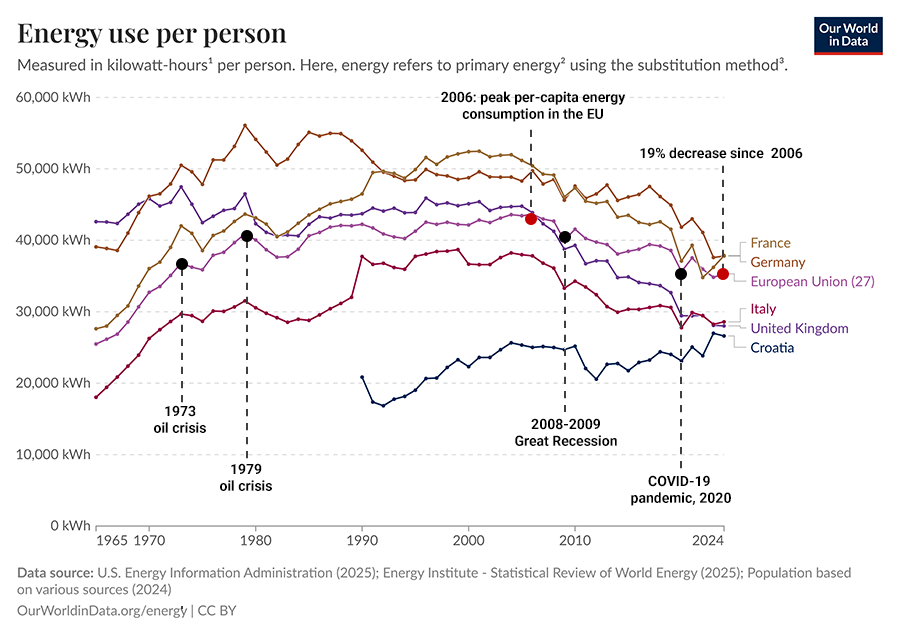
Two decades of the European Union's energy recession. Per-capita energy consumption in the European Union peaked in 2006, shortly after European fossil-fuel production in the North Sea passed its zenith – oil in 2000 and natural gas in 2005. Today, it is 19% lower than in 2006.
At the same time, digitalisation can become a powerful ally of the energy transition: smart grids, microgrids, and predictive consumption-management systems enhance both the efficiency and the stability of the electricity system. For example, every hour of surplus wind or solar energy that cannot be stored today represents lost energy forever. Although technology itself consumes ever more energy, it can also become a decisive tool for saving it. If technological and industrial leaders continue to advance innovations in energy storage, automated system management, and new forms of production, Europe can simultaneously strengthen sustainability, competitiveness, and resilience to energy insecurity.
All in all, investing in efficiency – saving energy, producing it locally, and building technological self-reliance instead of importing fossil fuels – would significantly reinforce Europe's resilience, reduce the risk of social tensions, recession, and dependence, and bolster political stability. In an era in which the amount of available energy per capita in Europe is gradually declining, maintaining the same standard of living means learning to conserve and to use intelligently what we already possess: the energy that provides us with warmth, light, and security. Only by saving the energy we would otherwise waste can we preserve the same amount of usable energy – the kind that truly generates prosperity.
This is the new European prudence: to consume less, produce more, and build resilience on a foundation of knowledge, conservation, and responsibility. Energy efficiency, in the broadest sense, is not merely a technical measure, but the cornerstone of social stability, civilised comfort, and national sovereignty.
Bread, Fuel, and Freedom
Agriculture most vividly illustrates how dependent civilisation is on energy. Two hundred years ago, eight out of ten Europeans lived from agriculture, and even then they barely managed to feed their families. Today, just two per cent of the population feeds an entire continent. How is it possible that forty times fewer people produce more food than ever before? The answer is simple: energy.
A modern tractor replaces the strength of more than a thousand labourers. Energy and power, however, are not the same: energy is a "reserve" that can be converted into work or heat (measured in joules – J – or, in the energy sector, often in watt-hours – Wh or kWh), while power is the rate at which energy is converted, the flow of energy per second (measured in watts, W = J/s), just as distance is measured in kilometres and speed in km/h. This distinction explains how machines can, in a single day, perform tasks that once required thousands of people.
The Haber–Bosch process, which produces nitrogen fertiliser from natural gas, increased yields per hectare five- to sevenfold compared with the early 20th century. Without fuel, fertiliser, and electric power for irrigation, processing, and transport, European agriculture would grind to a halt, and cities would go hungry.
This dependence on energy encompasses not only production, but also the physical ability of food to reach consumers. In the Middle Ages, without refrigeration and with food spoiling within days, the size of cities was governed by a simple constraint: how much food could be transported in three days by slow horse-drawn carts. This is why Paris remained below 20,000 inhabitants until around the year 1000 and reached half a million only in the eighteenth century, becoming the largest city of continental Europe only then, as expanding transport capacity gradually allowed it to make full use of its favourable location amid vast agricultural lands. Yet London overtook Paris around 1700 precisely because, thanks to maritime transport and the navigability of the Thames, it could bring food by ship directly into the very heart of the city.
Ancient Rome was the sole exception: by mastering Mediterranean logistics, it became the only city of Antiquity to approach one million inhabitants. This was made possible by maritime transport – 50 to 100 times more energy-efficient than land haulage – which allowed grain and oil to be shipped from Egypt and North Africa in sealed amphorae within two weeks by harnessing favourable winds. Once the Empire collapsed and these supply routes disappeared, Rome's population fell back to merely 20,000–30,000 inhabitants for centuries, reaching 100,000 again only in the early 17th century.
Today, thanks to airplanes and trucks, the "three-day radius" effectively encompasses the entire planet. Yet this very efficiency conceals a profound fragility: without continuous food deliveries, modern megacities would face shortages within days. For that reason, the decline in available oil – still irreplaceable in global logistics – poses an existential threat to megacities of the future. Battery-powered aircraft and transoceanic ships remain out of reach for decades, if ever, due to the low energy density of batteries. Without oil, supplying megacities that depend on global food chains would quickly become physically impossible.
The paradox of abundance is as striking as it is troubling: every year, Europe discards nearly one-fifth of the food it produces – a quantity twice the total weight of its own population. This wastefulness is not only morally reprehensible but also energetically absurd, because every tonne of discarded food already embodies a substantial amount of energy used in its production – in the form of fuel, water, fertiliser, transport, and packaging.
Energy dependence in agriculture has transformed the very destiny of humankind. Two centuries ago, without oil and gas, there were no weekends, no vacations, no mass schooling, and no pensions: people worked from childhood to death. Without energy, the young would till fields instead of studying, and the elderly would never live to see well-earned rest.
Without mechanisation, every family needed many children to cultivate the land that sustained it; birth rates would inevitably have remained high, migration to cities unthinkable, and industrial society would never have arisen. Thanks to fossil fuels, humanity underwent a demographic and social revolution. As machines gradually replaced human labour, fertilisers multiplied yields, and rural electrification extended the day and opened the path to education. Children were no longer a necessary labour force but a matter of family choice. As energy productivity rose, the need for numerous offspring declined. Where incomes and per-capita energy consumption grew, birth rates generally fell – as happened across the developed world. Where energy consumption remained low, as in parts of Central Africa, birth rates stayed high.
Pension systems – made possible by the economic surplus created through cheap energy – broke the millennia-old link between offspring and survival. Energy thus transformed not only production, but reproduction itself. It freed women from physical labour and opened doors to education, while turning childbirth from necessity into free choice. Energy liberated not only work, but life itself: it gave human beings time to learn, rest, and travel, and created the space for democracy, allowing freedom to become a shared good.
The Thirty Glorious Years and the Price of Illusion
The democracy we know today was not born in philosophical debates, but in factories and mines. The first modern democracies emerged where the Industrial Revolution began – in Great Britain, then in France and the United States. Coal, the driving force of steam engines, and later oil, enabled previously unimaginable productivity, accelerated urbanisation, and created the middle class.
Without abundant and inexpensive energy, that class would never have emerged: societies would have remained divided between a small minority of owners and a majority of dependent labourers. And without a middle class, there can be no stable or enduring democracy, for it is the economic foundation, social anchor, and political guarantor of democratic life.
The post-war boom known as the Thirty Glorious Years was the pinnacle of this process. During that period, cheap energy solidified a broad-based citizenry and opened the path towards a "consumer democracy." In the 1950s and 1960s, a barrel of oil cost around two US dollars, while productivity and wages grew at unprecedented rates. It was the golden age of the middle class, of mass housing construction, automobiles, and education – in short, a democracy fuelled by energy. Cheap energy was the engine of political stability.
This cycle of prosperity was broken by the oil shocks of 1973, and especially of 1979, which abruptly halted the rapid growth of European economies. Full employment vanished, and mass unemployment appeared – regardless of which political party held power. It was an unmistakable reminder that energy, more than any economic doctrine, is the decisive determinant of prosperity.
Figure 2. Energy: The Engine of Global Economic Growth
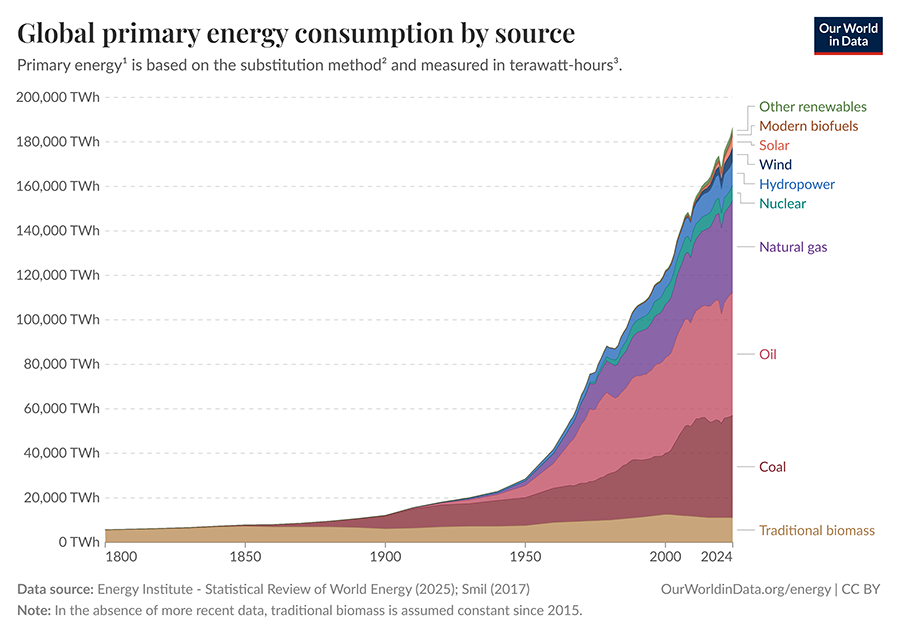
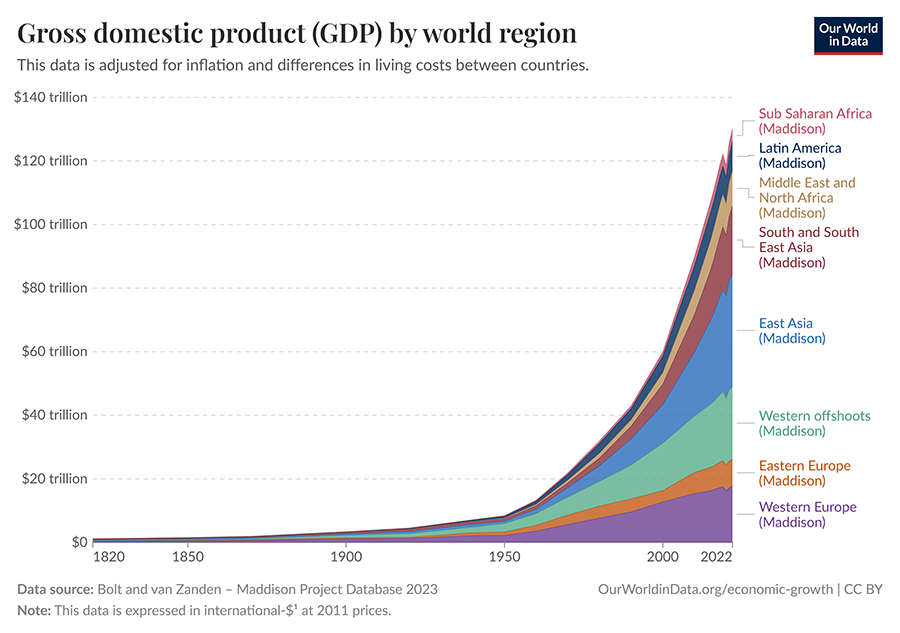
The curves of global energy consumption and global GDP are nearly identical: economic growth closely tracks the growth of energy consumption, especially after 1950. Despite the rapid development of renewable energy, its share remains modest – only about 8% of global energy production, with an additional 6% from hydropower – and cannot replace fossil fuels overnight, as they still provide more than 80% of the world's energy.
Since that time, Europe has lived in a state of persistent, if fluctuating, tension: the need to finance the welfare state – especially pensions, healthcare, and education – continues to rise, while real economic growth gradually weakens. This trend intensified after the aforementioned peaks in North Sea oil and gas production, and was further compounded after the 2008 financial crisis. The COVID-19 pandemic and Russia's aggression against Ukraine laid bare this vulnerability, exposing Europe's deep structural dependence on fossil fuels.
Today, a barrel of oil costs around 65 US dollars – thirty times more in nominal terms and nearly three times more in real terms than in the 1950s – and it will never return to its "golden price." This increase, even when adjusted for inflation, reflects the depletion of easily accessible reserves and the end of the illusion of limitless energy.
That illusion underpins Europe's model of growth, mobility, social redistribution, and civic peace – a system that remains viable only as long as energy is abundant, inexpensive, and supplied without uncertainty or threat. Now, confronted with the exhaustion of fossil resources and the approaching end of the age of cheap energy, that model has become as fragile as its invisible foundations.
According to analyses by the French energy-transition think tank The Shift Project, which specialises in energy and climate policy (Future oil supply – What are the risks for Europe?, 2021; Natural gas: what supply risks for the European Union?, 2022) global oil production could be cut in half by 2050 – a conclusion echoed in numerous IEA reports. Since global GDP follows oil production closely (Figure 2), such a shift would have far-reaching consequences: it would transform the economy, geopolitics, and – sooner or later – democracy itself.
If these projections materialise, after nearly three centuries of uninterrupted growth that began with the exploitation of coal, the world could enter a period of structural recession for the first time – a period in which real income, though not necessarily nominal income, gradually declines.
In such a world, a young person entering the labour market would have to accept the paradox without historical precedent: their first salary may well be the highest of their career. As energy becomes more expensive and productivity stagnates, real incomes would no longer rise with experience but would slowly erode over time. This would mark a profound reversal – the end of the historical era in which each new generation lived better than the previous one.
Yet societies are ill-prepared for such a prospect. The idea of a permanent decline in living standards runs counter to the very spirit of the modern age, in which progress is perceived as both natural and inalienable. Such a reversal would be almost unimaginable and could provoke deep social tensions, widespread disillusionment, and a loss of trust in the political order. In an atmosphere of collective frustration and fear, many democracies would struggle to resist the lure of authoritarian solutions.
Geological Limits: The End of Abundance
Governments of oil- and gas-exporting countries rarely address this reality openly: acknowledging the imminent scarcity of hydrocarbons would unsettle financial markets, undermine credit ratings, erode investor confidence, and weaken public morale. Yet the trend is undeniable. For half a century, major oil companies have been discovering fewer and fewer new fields, and today's finds are generally much smaller and of far lower potential than those of the mid-20th century; existing fields, moreover, decline unless sustained by enormous investment.
Data from British Petroleum (BP, BP Energy Outlook, 2025), the IEA (Oil 2025 – Analysis and forecast to 2030, June 2025) and the Norwegian firm Rystad Energy (The EU can expect to suffer oil depletion by 2030)show that the largest oil fields were discovered between 1950 and 1980, with a peak in 1965, and that by the 2000s new discoveries covered less than one-third of annual consumption. Claims that "peak oil" predictions were disproven often rest on a misreading of Hubbert: he never dated a global peak, but his forecast for the United States proved remarkably accurate, as conventional U.S. production did indeed peak in 1970. Today, despite technological advances and unconventional resources, a comparable depletion pattern is emerging at the global level, indicating that the world is entering a phase of structurally constrained oil supply. This unmistakably signals the onset of a permanent phase of resource exhaustion.
Figure 3. Global Oil and Gas Production by Field Status, 2024
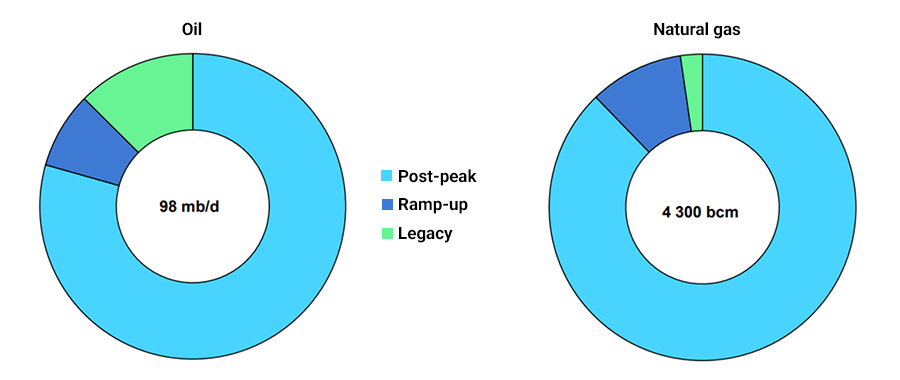
More depleted than growing. Approximately 80% of global oil production and 90% of global natural-gas production now come from fields that have already reached and passed their production peak. Source: iea.org.
Figure 4. Global Oil and Natural Gas Production without New Investment, and with Investment in Existing and Approved Projects
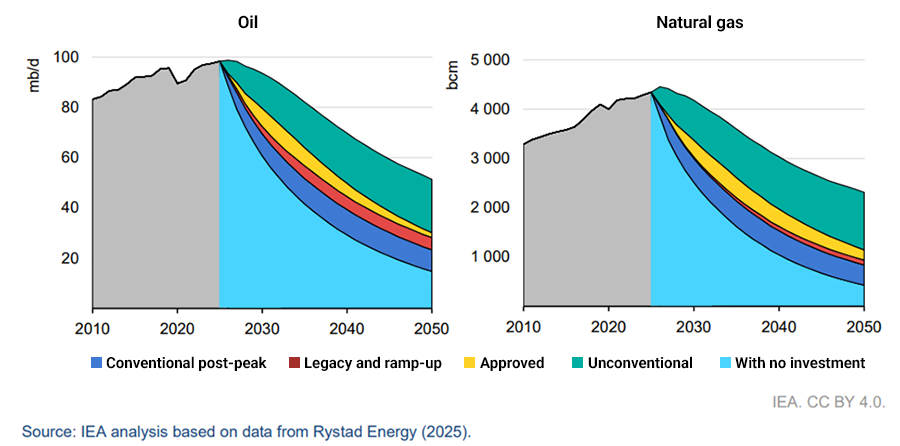
The end of the growth era. Even with new investment, global oil and gas production does not increase – it merely declines more slowly. Source: IEA.
According to the latest IEA report (The Implications of Oil and Gas Field Decline Rates, rujan 2025), in 2024 roughly 80% of global oil production and 90% of global natural-gas production originated from fields that had already reached and surpassed their peak, including unconventional sources (Figure 3).
This report – the most comprehensive study of its kind ever produced by the IEA, the world's leading authority on energy policy – demonstrates that the world faces severe constraints on fossil-fuel supply. The analysis draws on historical production data from around 15,000 individual oil and gas fields with reliably documented records – an unprecedented dataset. It shows that nearly 90% of current investment in the oil and gas sector serves merely to slow the rate of decline, not to expand production.
The average decline rate of existing conventional oil fields is around 5.6% per year, and 6.8% for natural-gas fields; without new investment, these rates would reach 8–9% (Figure 4). This means that each year the world must replace roughly 5.5 million barrels per day of lost production – more than the combined output of Brazil and Norway. In other words, the global energy system is already running ever faster merely to stay in place. Technology now enables extraction in locations once considered inaccessible – deep-water fields, shale oil, and bitumen sands – but these reserves are neither infinite nor equivalent in quality. Their exploitation is slower, costlier, and far more energy-intensive. According to the IEA, the share of oil from unconventional sources has risen from 3% in 2000 to nearly 25% in 2024, yet such fields deplete many times faster than conventional ones and require continuous investment merely to maintain output.
When Energy Consumes Itself
Where once only a small amount of energy was required to produce a barrel of oil, today far more is needed. The energy return – EROI (Energy Return on Investment), the ratio between energy gained and energy spent – has fallen from 30:1 in the 1970s to only 12–15:1 today, and to as little as 3–5:1 for unconventional oil. Each new field yields less net energy, as an ever-greater share is consumed merely to extract it. Without constant reinvestment, the IEA warns, production from such sources declines by more than 35% in the first year and another 15% in the second. Technology cannot override the geological laws of extraction: each barrel effectively consumes part of its own strength to make the next one possible – resulting in permanently rising costs and falling net output. Geology sets the limits of what is possible; thermodynamics sets the price.
Humanity has already crossed the threshold beyond which additional production requires exponentially greater effort for diminishing returns, not because of politics but because of the Earth's geology itself. According to the same report, by 2050 the world would need to discover and develop around 230 billion barrels of new reserves merely to maintain current production levels – twice the total volume of all new discoveries over the past two decades combined, and therefore highly implausible. These data show unequivocally that depletion is no longer a future risk but a present reality.
And the cost is measured not only in economic terms, but also in political sovereignty. History demonstrates that energy dependence inevitably translates into political dependence. What was once a question of growth has become a question of power – and ultimately, of survival itself.
Without Energy, There Is No Sovereignty
Freedom, too, depends on this equation. Without energy, there is no industry, no modern agriculture, and no military capable of movement, defence, or protection. Military power flows directly from a state's energy base: without fuel, there is no logistics, and without logistics, there is no security.
For Europe – which is almost entirely dependent on imported oil and gas, and to a lesser extent coal – this equation carries decisive strategic weight: economic, political, and security-related. Its proximity to Russia, an authoritarian power endowed with vast energy resources and willing to wield them as instruments of coercion, should continually remind Europe that energy independence is the first condition of political freedom and lasting peace. This is precisely why the European Union adopted the REPowerEU plan, aimed at ending imports of Russian fossil fuels by 2027 at the latest – a crucial step towards reducing vulnerability and strengthening sovereignty. Whoever depends on another's energy will, sooner or later, depend on another's will. Croatia learned that lesson in time: with the strategic decision taken in 2019 to build the LNG terminal on the island of Krk in the northern Adriatic, it secured full independence from Russian gas – an essential advance in strengthening its energy, and therefore political, sovereignty.
This is why Europe's energy policy must also be its economic and security strategy: the question of energy – its availability, sustainability, and price – is no longer a technical or market issue but a fundamental civilisational test and a precondition for the survival of European democracy.
Today, the European Union stands at a historic crossroads. Declining domestic production, persistently high prices, and intensifying global competition for access to resources threaten not only its competitiveness but also the stability of its institutions. Energy has become a measure of sovereignty and a foundation of social trust and political stability, because its rising cost and inevitable scarcity increasingly define the limits of economic and political power.
Increasing the share of renewable and other low-carbon sources in the energy mix is not merely a technical or environmental undertaking – it is a political and civilisational act, an act of renewing the social contract in a world where scarcity is becoming the new norm.
Over the past 120 years, thanks to cheap and accessible fossil energy, humanity has experienced the greatest reduction in poverty in history: at the beginning of the 20th century, three-quarters of humankind lived in extreme poverty, whereas today the share is below ten per cent. That era of abundance shaped our entire civilisation, but the world now emerging rests on different foundations. Electrification, agricultural mechanisation, irrigation, and the expansion of mobility all played decisive roles in this transformation.
Yet as available resources diminish, scarcity will rise again and begin to reverse that trend – a shift already visible in recent years. The prosperity of post-war Europe rested on cheap oil and on faith in endless growth; the prosperity of the 21st century, by contrast, must be built on energy that is costlier, scarcer, and more wisely used – on efficiency, moderation, and fairer distribution.
Can we reasonably justify, under such conditions, that one Qatari consumes as much energy as eight Croatians, twenty-eight Indians, or four hundred Nigeriens? Estimates of inequality (based on CO₂ emissions, a robust – though not perfect – proxy for energy consumption) show that the richest ten per cent of the world's population consumes roughly half of the global "energy pie," while the poorest half – around four billion people – consumes only barely eight per cent combined.
In a world of limited energy resources, the question of their distribution is not merely economic or environmental but above all a political, strategic, and social. For energy determines the stability of communities and the resilience of democracy. Preserving freedom in a world of shrinking flows of energy requires relearning restraint, rekindling solidarity, and restoring prudence. Only these virtues can replace abundance with fairness – and power with endurance.
The Limits of Technological Salvation
Many still believe technology will spare us the need for restraint. This techno-solutionist story – engineering miracles presented as the answer to the climate and energy crisis – rests on a dangerous illusion: that technical progress can liberate us from the constraints imposed by the laws of nature.
This faith in a technological deus ex machina is not only naïve but actively harmful: it breeds passivity in the face of climate and energy challenges, for it quietly assumes that science and engineering will, in the final hour, conjure up some miraculous and salvific solution. Yet no invention can circumvent the laws of nature: they govern the universe with absolute authority and have remained unchanged since the Big Bang. Innovation is, of course, indispensable – without it we would still be in the Stone Age – but its power has limits that even the brightest human mind cannot cross.
Technological progress can refine the tools at our disposal, increase their efficiency, and partially alleviate our constraints, but it cannot abolish the boundaries imposed by the laws of nature – the same laws that apply everywhere in the universe and constrain both natural and artificial intelligence alike. Acknowledging these limits does not mean renouncing progress, but rather preserving prudence: not expecting miracles where they are physically impossible, neither today nor in the distant future.
To believe otherwise is to replace political prudence with technological messianism – the ambitious and dangerous belief that humanity, through technology, will overrule the laws of nature: that fusion will deliver limitless energy, that artificial clouds will arrest climate change, that artificial intelligence will repeal the laws of physics, and that we will decamp to Mars at will...
It is telling that such expectations are not voiced by those with genuine scientific expertise. That alone should serve as a sufficient warning.
When the Lights Begin to Flicker
Solutions do exist. They require determination, not despair. Europe must launch its own "energy plan for freedom" – as ambitious as the Marshall Plan, but directed towards moderation, sustainability, and decarbonisation. Such a plan must include a systematic increase in the share of domestic, clean, and renewable energy in total consumption, with a strong emphasis on efficiency and the gradual reduction of dependence on fossil-fuel capacity. This means renovating and insulating millions of buildings; shifting as much freight as possible from road to rail, which is five to ten times more energy-efficient; expanding telework; and supporting forms of agriculture that use energy and resources more rationally, not least by reducing excessive meat consumption. It also means limiting waste, encouraging recycling and the development of a circular economy, and investing in low-consumption technologies.
At the same time, Europe must rapidly increase the share of low-carbon electricity generation – renewable and nuclear – within its overall energy mix, because as fossil fuels become scarcer and more expensive, no society can remain secure, sustainable, or stable without reliable and clean sources. According to IEA projections, oil, gas, and coal will reach a 'triple peak' between 2030 and 2040 – in other words, very soon. That historical turning point will mark a deeper change than the decline in European production already under way. While the world was still growing, Europe could offset its own losses by purchasing energy on the global market. The examples of countries that have already crossed this threshold clearly warn of what lies ahead: Indonesia, Egypt, Syria, Argentina, the United Kingdom, Yemen, Mexico, and even China. Once exporters or self-sufficient producers, these countries gradually became net importers after their own energy peaks, forced to retain an ever-larger share of production for domestic needs.
But once global production begins to decline, exporters will increasingly reserve energy for their own consumption, and the quantities available for export will shrink year after year. In a world of growing scarcity, energy will go to those able to pay the highest price. Europe – a major importer without rapid alternatives – will pay dearly for its dependence.
Energy Sovereignty: Meeting One's Own Needs with Clean Energy
To confront this challenge, Europe must establish accelerated procedures, special financing mechanisms, and joint funds – but above all, it must permanently increase the share of its own clean and stable sources, renewable and nuclear alike, in meeting its energy needs. This is the new lever of European sovereignty: every kilowatt-hour produced in Europe, whether from wind, sun, water, biomass, geothermal sources, or the atom, reduces our dependence on those who might one day seek to blackmail us or sell us energy at the price of gold.
But for the gradual reduction of fossil fuels to be truly self-sustaining, Europe must expand its own industrial capacity to produce solar panels and reduce its industrial dependence on China, which currently controls around 60% of global rare-earth extraction and nearly 90% of refining capacity. These metals and elements are indispensable to all technologies of the green transition – from solar cells and wind turbines to batteries and electric vehicles – because without them, renewable-energy capacity cannot be built at scale. Europe must avoid replacing one dependency – on oil and other fossil fuels – with another, namely on rare-earth elements and critical metals such as copper, nickel, cobalt, and tin, whose global reserves are limited and already under growing pressure from surging green demand. In this regard, and given Europe's structural resource constraints, the EU Action Plan for the Circular Economy plays an important role. Only by strengthening its own industrial and technological base can Europe, in the long term, reduce strategic dependencies, balance its energy mix, and ensure stable and secure production from clean and renewable sources.
Croatia, a member state of the European Union, enjoys in this respect an advantage that is rarely highlighted: more than one-third of its total energy consumption comes from renewable sources – twice the share of Germany, France, or Italy, and nearly three times that of the United Kingdom (Illustration 5). This demonstrates that energy resilience and sovereignty are built not only on the scale of an economy but also on the intelligent stewardship of national resources – particularly hydropower, solar, and wind, of which Croatia has an abundance.
Developing renewable energy sources is not only an ecological imperative but an act of power, security, and social cohesion. It guarantees industrial continuity, economic prosperity, and democratic stability. It is a project that demands the seriousness appropriate to major crises: action must be swift as in wartime, though with the goal not of victory but of establishing lasting peace.
At the same time, Croatia must secure long-term, stable sources of electricity that are not vulnerable to weather variability. If it cannot reach an agreement with Slovenia on building a second unit of the Krško Nuclear Power Plant, Croatia should seriously consider developing its own nuclear capacity, particularly through the promising technology of Small Modular Reactors (SMRs). These new reactors – now being rapidly developed across several European countries, although none has yet entered commercial operation in Europe – offer potentially lower costs, shorter construction times, and very high safety standards compared with conventional nuclear plants. By adopting them, Croatia could achieve near-complete independence in electricity generation – tomorrow's main lever of political sovereignty and freedom – while ensuring a stable and affordable power supply, a prerequisite for industrial competitiveness. If Croatia leverages its advantages effectively, it may not only meet its own needs but also emerge as a regional exporter of energy and expertise.
Energy – the silent engine of freedom – is also its Achilles' heel. Europe is already sensing early warning signs: a series of major electricity outages, from Prague in 2022 to southern Croatia, Albania, Montenegro, and Bosnia and Herzegovina in 2024, and then Spain and Portugal in 2025, have exposed the fragility of power grids and the mounting strain on supply systems.
Some of these disruptions stem not only from the ageing infrastructure and chronic underinvestment in modernisation, but also from the growing volatility introduced by intermittent sources such as wind and solar. As their share expands, Europe faces a paradox: to reduce energy dependency, it must increase renewable production – yet simultaneously prevent large fluctuations from destabilising the system.
Figure 5. Share of final energy use that comes from renewable sources, 2021
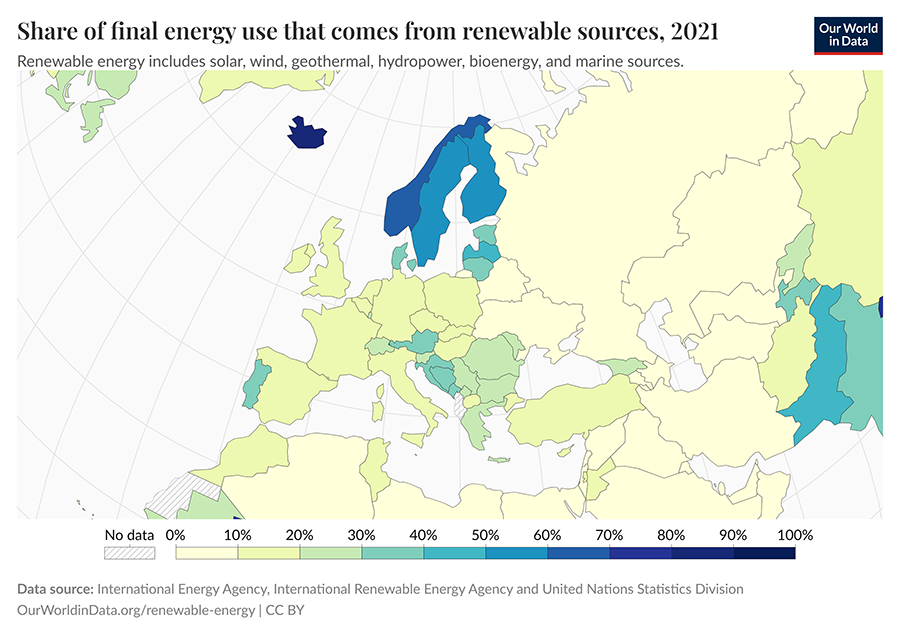
Croatia, with a 34% share, ranks seventh in the European Union, behind Sweden (58%), Finland (50%), Latvia (44%), Denmark (40%), Estonia (38%), and Austria (36%). Source: OurWorldInData.org.
This is why the development of storage systems becomes crucial – particularly pumped-storage hydropower plants, the most proven, reliable, and environmentally acceptable means of storing large quantities of electricity and smoothing daily and seasonal fluctuations in the power system. In countries lacking suitable geographical conditions, solutions based on green hydrogen are being increasingly developed, especially for long-term and seasonal storage. For long-term stability, it is essential to maintain a balanced energy mix combining renewable and stable sources – nuclear energy, hydropower, geothermal plants, and biogas – while giving priority to renewable solutions whenever they are technically and economically viable (Figure 6). These still occasional disruptions show that a system operating at the limits of its resilience can falter at any moment. Energy security therefore depends not only on how much electricity is produced but also on its stability, reliability, and predictability. Europe will grasp the true extent of its dependence only when the lights flicker again, supply chains begin to break, and the price of fuel becomes the ultimate measure of power – and of powerlessness.
Figure 6. Not All Kilowatts Are Created Equal
Average greenhouse gas emissions in grams per kilowatt-hour of electricity (CO₂-eq/kWh)
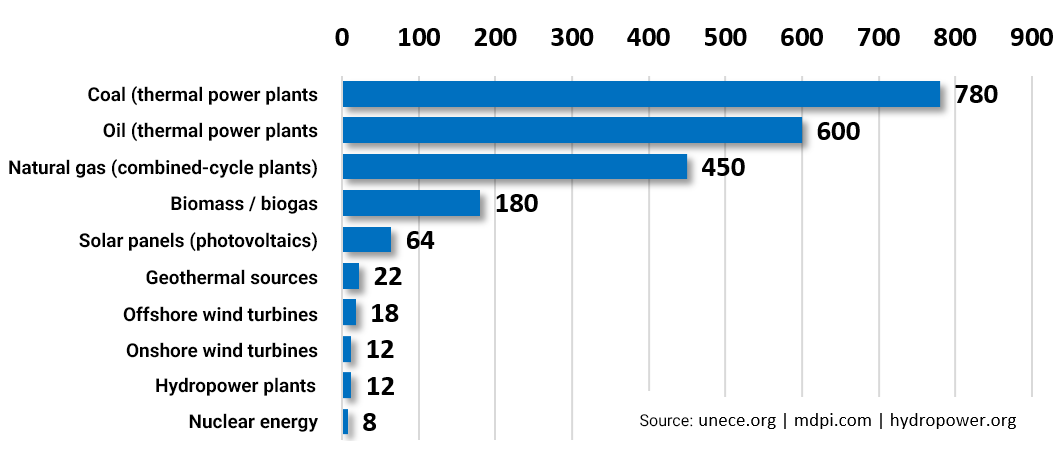
Electricity can have an almost negligible carbon footprint – or be exceedingly "dirty": everything depends on how it is produced. A kilowatt-hour from a nuclear plant or a wind turbine emits only a few grams of CO₂, whereas the same kilowatt-hour from coal can emit up to two hundred times more. Thus, an electric car is not necessarily clean: if it is charged with electricity generated from coal, it indirectly "emits" far more CO₂ than when it is powered by nuclear or renewable energy. In such cases, the absence of a tailpipe does not mean the absence of emissions – they have merely been released upstream, at the power plant that generated the electricity stored in the battery.
The price of energy is not merely an economic indicator but also a barometer of social cohesion and political stability. When energy becomes scarce and expensive, everything begins to falter: production slows, incomes stagnate, inequalities widen, and the trust on which democracy rests begins to erode.
In times of energy scarcity, demagoguery reawakens: fear of shortage fuels discontent, populism feeds on resentment, and authoritarian temptations return in the name of order and survival. It then becomes clear that democracy is not only a political ideal but also a living energy system that requires the constant renewal of its vital force. If this renewal fails, democracy can transform into precisely what it sought to prevent – an authoritarian order born of scarcity and fear.
We still have time to realise that the true transition is not merely an energy transition, but a civilisational one: a gradual change in how we produce, consume, and understand power itself. Without changes in values, habits, and behaviour, even the most advanced technologies will not suffice. Education plays a key role in this transformation: it shapes generations that understand the limits of the world they inhabit, act prudently and fairly, and recognise moderation as a new form of freedom.
For this reason, the European Union should compensate for its structural disadvantages by significantly increasing investment in education, research, and development, enabling it to become the continent that most deeply understands the realities of energy and the challenges that flow from them. Such a qualitative advantage in knowledge and awareness would give Europe new strategic strength: it would foster innovation, enhance resilience, and reduce long-term structural vulnerabilities.
The model of unlimited growth – to which the world economy still clings – is less than three centuries old, a mere blink in human history. Before the age of coal and oil, a 17th-century farmer's output was only slightly greater than that of an ancient agricultural worker. Over the last thirty years, the world economy has grown by roughly three per cent per year. At that pace, production would increase twentyfold in a century and several hundredfold in two – an impossibility on a planet with finite resources.
Even with growth of only two per cent annually, global output would increase sevenfold over a century and fiftyfold over two centuries – requiring, in principle, fifty times more material resources from land and sea. Infinite material growth is, however, a physical impossibility in a world of limited stocks.
Countries that have not yet faced energy scarcity will struggle to adapt to new conditions. But if Europe learns sooner than others how to achieve the same or better outcomes with fewer inputs, it can become a continent of energy efficiency and sustainable development, thereby gaining a decisive advantage. That choice lies entirely with us.
If the 20th century was the age of energy that liberates, the 21st century must become the age of energy that obliges and connects. At the root of every future crisis – economic, social, political, or geopolitical – will lie energy: its shortage, its price, or its unequal distribution. A Europe that consumes far more than it produces becomes dependent not only on markets but also on the will of other powers; and when such dependence reaches the realm of security, it easily turns into subordination.
This is precisely why European unity is not the opposite of national sovereignty but its essential precondition: only by standing together can our states retain political weight and economic strength in a world increasingly shaped by the United States, China, India, and Russia.
The era of expensive and scarce energy will be the greatest test of European solidarity. Will the wealthiest European Union member states agree to share a shrinking and costly supply of imported oil with the less developed ones, or will each seek to save itself, stockpile resources, and leave others in the dark? That moment will determine the Union's fate: whether it affirms its unity or fractures into energy islands with diverging interests.
Although human nature inclines us to worry more about the end of the month than the end of the world, the moment is approaching when the world will enter an era of energy recession – and Europe will feel it first. This is precisely why we must devote far greater attention to this existential threat and address it with far greater seriousness, for every delay deepens dependence and weakens resilience. We face a choice: will we simply endure the coming recession, or will we prepare and organise ourselves in time to meet it as ready as possible – and perhaps even overcome it? A forced reduction in available energy amounts to a form of energy impoverishment; a conscious and timely adjustment to that same inevitable reality is an act of prudent frugality aimed at preserving living standards. In the first case, constraints are imposed upon us; in the second, we choose how best to live within them.
But if Europe draws the lesson in time – if it learns to see energy not merely as a commodity but as a shared good of freedom – it can emerge from this trial stronger and more just. By expanding clean and renewable capacity, we secure not only electricity but also our children's future – a future free of social insecurity, political subjugation, and poverty. True independence does not mean having more energy, but using it more wisely and producing enough of it ourselves. This requires responsible governance, long-term and strategic economic thinking, and citizens willing to change their habits, for the energy transition is not only a technical process but also a cultural and moral test of maturity.
The answer to this question will determine not only the warmth of our homes and the price of fuel but also the fate of democracy itself. Will democracy endure as a living form of freedom, or will it sink into a vortex of crises and dependencies, easy prey for forces waiting for the moment of its weakness? For a society that loses the capacity for self-sufficiency will inevitably lose its sovereignty – and with it, its freedom.
If democracy is to endure, it must learn to transform power into wisdom, consumption into responsibility, and energy into freedom. Fossil fuels – especially oil – cannot be fully replaced for a long time to come, yet they will become ever scarcer, costlier, and harder to obtain. Europe can and must reduce its dependence on them by investing in efficiency, frugality, and the prudent use of every available unit of energy. If it finds the strength to transform its renewable and low-carbon energy sources from a foundation of dependence into a foundation of freedom, Europe can remain – or once again become – a place of hope for its citizens and for the world.